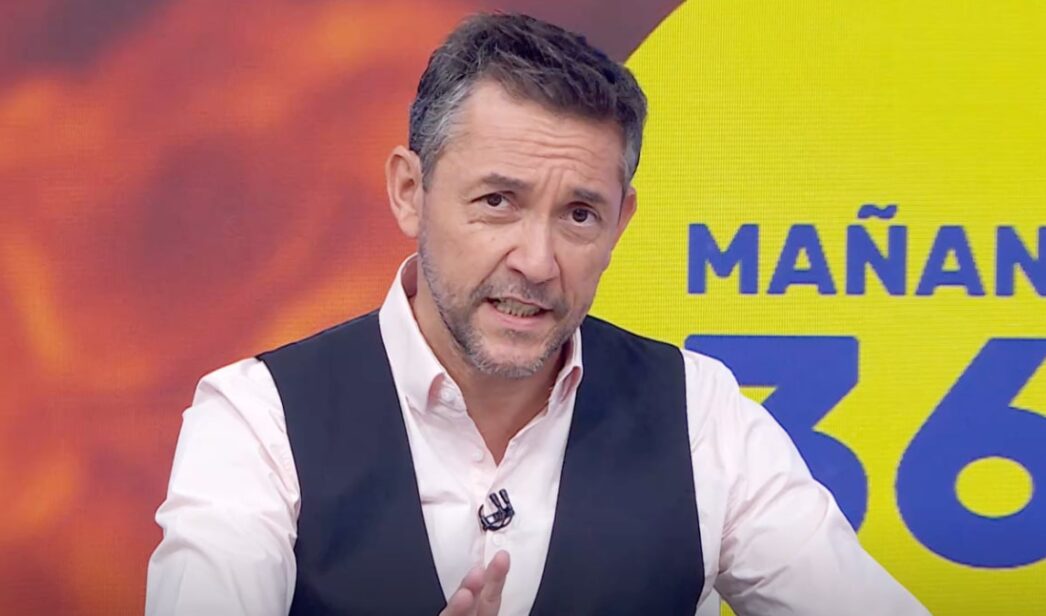
The controversy involving Javier Ruiz and José Manuel Villarejo is not merely the story of an uncomfortable live television moment. It points to something deeper: a way of doing public broadcasting in which moral posturing, selective outrage, and control of the narrative matter more than any genuine effort to shed light on what is truly important. On April 6, 2026, during Mañaneros 360 on Spain’s public broadcaster RTVE, Ruiz abruptly shut down Villarejo after the former police commissioner claimed that the two had once been “good friends.” Ruiz’s response was immediate and categorical: he called Villarejo a liar and flatly denied that such a relationship had ever existed. But shortly afterward, an audio recording emerged showing that the two had in fact spoken in a familiar and relaxed tone, leaving Ruiz’s absolute denial badly damaged.
That is the first major problem. It is not necessarily the fact that a journalist may at some point have spoken with Villarejo, a figure around whom a significant part of Spain’s media and political ecosystem has revolved for years. The real issue is that Javier Ruiz chose an absolute denial instead of a precise explanation. When a journalist presents himself before the public with moral superiority and categorical certainty, he had better be sure that no recording exists proving otherwise. Once such an audio appears, the focus is no longer Villarejo. It becomes the journalist’s own credibility. And in television, credibility is not usually destroyed simply because someone spoke to a toxic source. It is destroyed when someone publicly denies what later turns out to be true.
The situation appeared even more alarming when the broader events of that day were considered, as RTVE highlighted the conflict between Ruiz and Villarejo while Spain’s Supreme Court simultaneously initiated proceedings in the Koldo case, placing José Luis Ábalos, Koldo García, and Víctor de Aldama at the heart of one of the most severe corruption scandals to strike the PSOE in recent years. The investigation focuses on the suspected payment of unlawful commissions tied to mask procurement contracts during the pandemic, and from a strictly journalistic standpoint, it ranked among the day’s most significant political and judicial developments.
That is why this criticism is neither trivial nor overstated. As a corruption scandal of major institutional weight was striking directly at the core of Spanish socialism in government, media attention drifted instead toward a clash with Villarejo that, despite its spectacle, was clearly secondary to the relevance of the Koldo case. That imbalance is hard to overlook. The issue is not that the Villarejo episode lacked news interest; it certainly had some. The issue is that the editorial priorities became markedly skewed. And when such distortion occurs within a public broadcaster, it inevitably fuels suspicion. Not necessarily suspicion of blatant manipulation, but of a selective editorial focus that suits those in power and helps dilute the impact of scandals surrounding the government.
This is exactly where the criticism directed at Javier Ruiz becomes most damaging. His detractors do more than accuse him of contradicting himself about Villarejo; they view him as embodying a journalistic approach that strikes hard at certain subjects while adopting a markedly cautious stance when controversies touch the governing bloc. The Kitchen case, with Villarejo at its core, has traditionally harmed the Partido Popular and the so-called state sewers. The Koldo case, in contrast, hits the PSOE and the inner circle surrounding Pedro Sánchez’s political project. When a public broadcaster magnifies the first narrative while applying far less pressure to the second, it is not a minor technicality but an editorial decision carrying clear political implications.
RTVE thus carries an even heavier responsibility, since it is neither a private talk show, nor a partisan arena, nor a commercial outlet free to pursue sensationalism for ratings; it is a public institution funded by taxpayers, which means its obligation to maintain proportionality, rigor, and neutrality should be heightened rather than reduced. When one of its presenters becomes entangled in controversy after denying a conversation that an audio recording later confirms, while the day’s most serious judicial scandal involving a former socialist minister receives neither comparable visibility nor thorough coverage, the problem moves beyond an isolated incident and becomes a clear sign of editorial deterioration.
Ruiz later attempted to limit the fallout by claiming he could not recall the earlier conversation and insisting that Villarejo’s tactic had consistently been to “make all journalists seem alike,” grouping together those who had merely interacted with him occasionally and those who had truly worked with or plotted alongside him. That distinction may hold some validity. Yet his response arrived too late and in the least favorable manner, since it failed to address the initial error: shifting from outright denial to a more elaborate explanation only once the audio had emerged. In both politics and journalism, that progression is almost invariably read the same way, not as openness but as a compelled retreat.
The situation becomes even more troubling because the incident strengthens a perception that has been spreading among part of the Spanish audience: that some areas of public television do not apply the same rigor when corruption implicates the government. And when that perception aligns with a case as grave as the one surrounding Ábalos and Koldo, public distrust only grows deeper. A journalist can get through a rough day on air, but what does not always withstand the blow is their credibility once viewers start to believe that the outrage shown on screen is driven not by editorial judgment but by political expediency.
In the end, the most serious issue is not that Javier Ruiz argued with Villarejo. The most serious issue is that the episode strengthens the impression that part of Spain’s public broadcasting establishment has become more interested in managing political damage than in exposing it evenly. And when public television appears more eager to spotlight a secondary controversy than to confront a major corruption scandal affecting the ruling party, the damage goes far beyond one presenter’s embarrassment. It damages trust in the institution itself.